
ISO 14001:2026 Certification: Process, Changes and Transition
ISO 14001:2026 certification is for organisations that want an independently audited environmental management system based on the latest edition of ISO 14001. The standard was published on 15 April 2026 and replaces ISO 14001:2015, including the 2024 climate amendment.
For businesses, this update is not only about changing a few words in an EMS manual. ISO 14001:2026 gives clearer attention to climate-related issues, biodiversity, life cycle thinking, supplier controls, and planned changes through Clause 6.3.
This page explains what ISO 14001:2026 certification means, what changed from ISO 14001:2015, how the transition works, what documents are usually required, and how businesses can prepare for certification or transition without waiting until the last moment.
ISO 14001:2026 Key Facts at a Glance
| Parameter | Details |
| Standard Name | ISO 14001:2026 |
| Full Title | Environmental Management Systems — Requirements with Guidance for Use |
| Edition | 4th Edition |
| Published | April 15, 2026 |
| Replaces | ISO 14001:2015 + ISO 14001:2015/Amd 1:2024 (Climate Amendment) |
| Transition Period | 3 years from publication date |
| Transition Deadline | Approximately April–May 2029 (pending IAF mandatory document confirmation) |
| Valid For | All industries and organisation sizes, worldwide |
What Is ISO 14001:2026?
ISO 14001:2026 is the global standard for Environmental Management Systems (EMS). It gives organisations a structured, internationally recognised framework to identify their environmental impacts, set objectives for improvement, demonstrate legal compliance, and build continual improvement into their everyday operations.
The standard is not prescriptive about specific numerical environmental targets. Instead, it requires organisations to commit to a systematic approach — covering everything from how they assess environmental risks and plan changes, to how they manage their suppliers, prepare for emergencies, and measure their own performance.
An ISO 14001:2026 certificate, issued by an accredited certification body, signals to customers, regulators, investors, and supply chain partners that your organisation has a robust, independently audited environmental management system in place — not just a policy document on a shelf.
Five Key Changes in ISO 14001:2026 Every Organisation Needs to Act On
If you need a quick summary before going deeper, these are the five changes that will have the greatest practical impact for most organisations:
- Climate change is now a core requirement — not an amendment, but built directly into Clauses 4.1 and 4.2
- Biodiversity and resource scarcity must be assessed — named for the first time as environmental issues requiring formal consideration
- New Clause 6.3 mandates structured change management — every significant EMS change must go through a planned environmental review
- Life cycle perspective is strengthened — environmental responsibility now extends explicitly across your entire supply chain
- Leadership accountability is extended — EMS responsibility now applies to all relevant roles, not only top management
What Changed? ISO 14001:2015 vs. ISO 14001:2026
| Area | ISO 14001:2015 | ISO 14001:2026 |
|---|---|---|
| Climate change | Referenced via 2024 amendment only | Explicitly embedded in Clauses 4.1 and 4.2 as a core requirement |
| Biodiversity | Not mentioned | Named as a specific environmental issue to assess and address |
| Natural resources | General reference | Water, soil, pollution levels, and resource scarcity explicitly included |
| Change management | No dedicated requirement | New Clause 6.3: structured planning of EMS changes mandatory |
| Life cycle perspective | Required | Strengthened with a new explanatory note across the full value chain |
| Supply chain / outsourced | Outsourced processes | Externally provided processes, products and services: broader scope |
| Leadership accountability | Top management responsibility | Extended to all relevant roles across the organisation |
| Clause 6 structure | Risk and opportunity combined | Reorganised: Clause 6.1.4 for risks/opportunities and Clause 6.1.5 for planning actions |
Who Needs ISO 14001:2026?
ISO 14001:2026 applies to any organisation, regardless of size, sector, or geography, that wishes to establish, maintain, and improve an EMS. It is particularly relevant for:
- Manufacturing and production companies
- Construction and infrastructure firms
- Logistics, transport, and warehousing operators
- IT and software service organisations
- Healthcare and pharmaceutical companies
- Food and beverage producers
- Energy, utilities, and oil and gas companies
- Exporters and businesses competing for government procurement contracts
- Any organisation with ESG reporting obligations or investor sustainability requirements
The Evolution of ISO 14001 — 1996 to 2026
From 1996 to 2026 – Building Stronger Environmental Management Systems and Preparing for the 2029 Transition
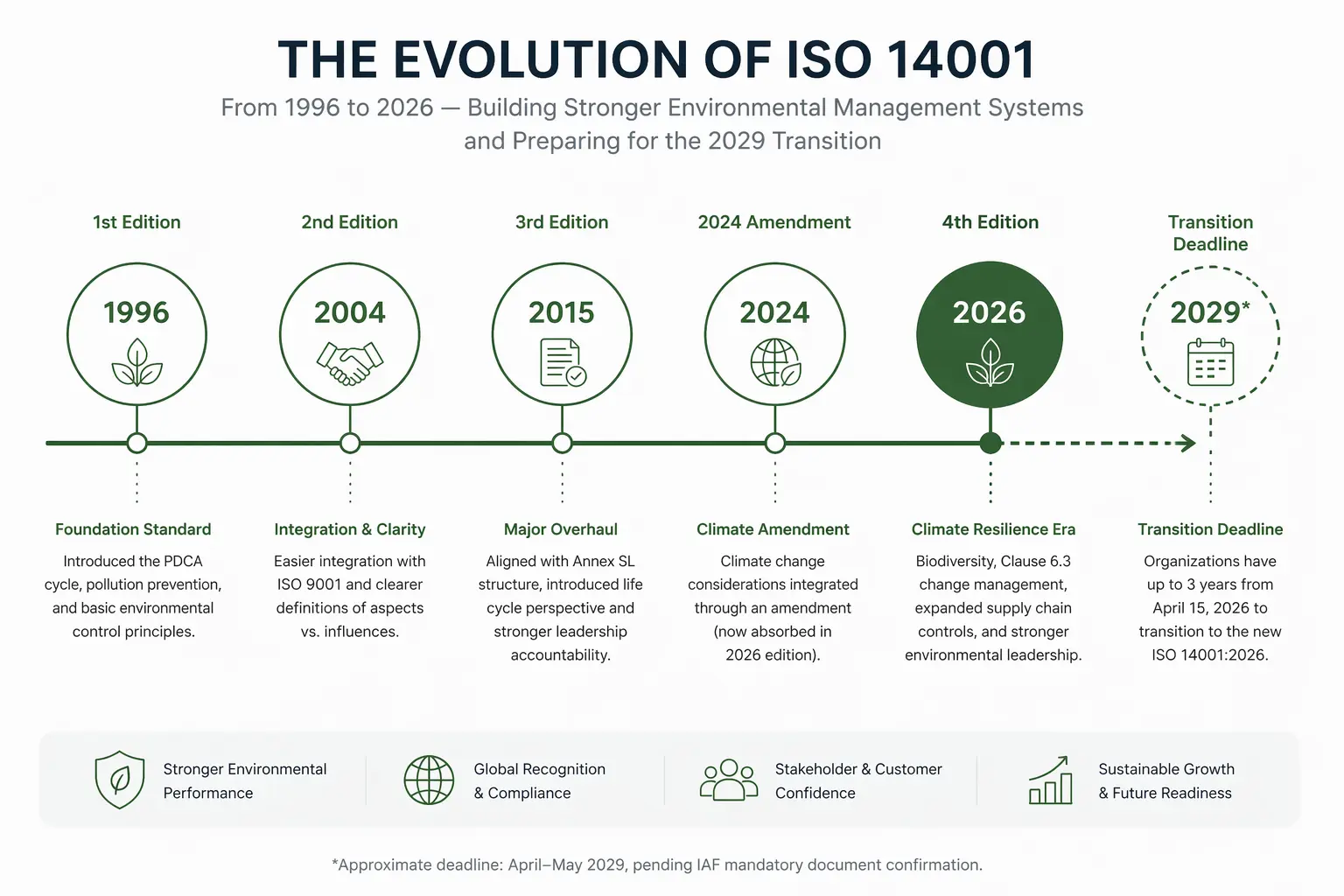
ISO 14001:2026 Transition Timeline
ISO 14001:2026 was published on 15 April 2026. Public guidance from certification bodies and related sources is broadly pointing to a 3-year transition window from publication, taking organisations to approximately April to May 2029. Because transition wording is still best read alongside the applicable certification route, businesses should avoid waiting for the last minute.
Three years can sound like plenty of time. In practice, organisations that delay often create avoidable pressure around internal review, audit planning, supplier controls, and resource availability.
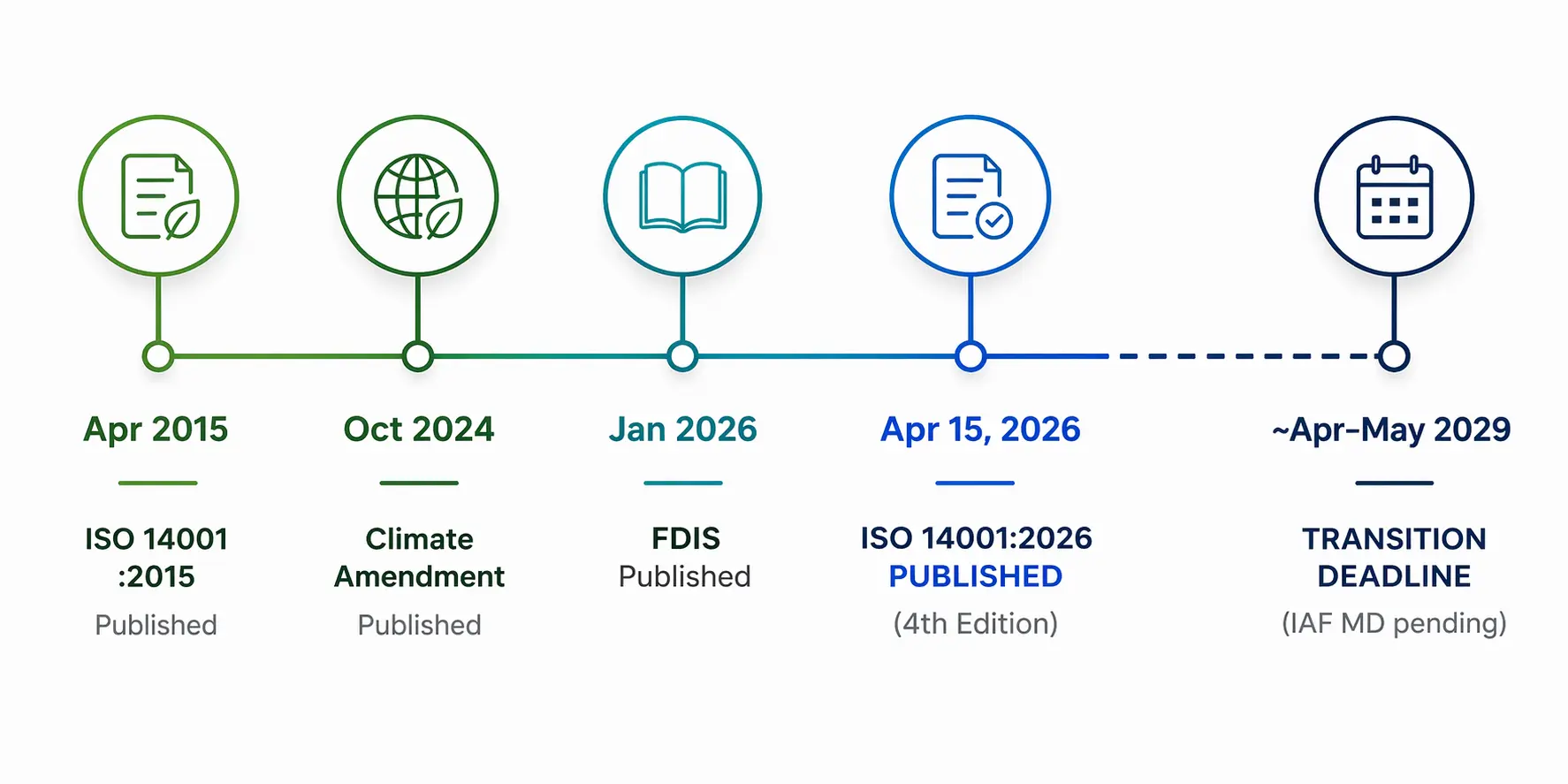
Three years sounds like a long time. In practice, organisations that delay often find audit capacity across accredited certification bodies become constrained as the deadline approaches — and transition audits combined with scheduled surveillance visits are significantly more cost-effective than stand-alone transition audits booked at the last minute.
If your organisation has not transitioned to ISO 14001:2026 by the deadline, your existing ISO 14001:2015 certificate will be marked as expired/invalid on the IAF CertSearch public register and will no longer be accepted for government tenders, export documentation, or procurement requirements.
New Clause 6.3 — Planning of Changes
One of the most important practical additions in ISO 14001:2026 is Clause 6.3 on planning changes. This section makes it clearer that organisations need a structured way to review changes that could affect the environmental management system.
In practice, that includes things like new suppliers, site changes, process redesign, new product lines, outsourced services, changes in materials, or changes in operational scope. The point is simple: when the business changes, the EMS should keep up.
Climate Change and Biodiversity Now Explicitly Required
For the first time, ISO 14001:2026 embeds climate change directly into the core context analysis requirements of Clauses 4.1 and 4.2. The 2024 climate amendment, which was previously a separate document, has been fully absorbed into the body of the standard.
Biodiversity loss, pollution prevention, and natural resource scarcity — including water, soil, and raw material availability — are now named as specific environmental issues that must be formally assessed. Auditors will expect to see documented evidence that these considerations are integrated into your aspect-impact register and environmental objectives, not just acknowledged in a policy statement.
Expanded Life Cycle Perspective and Supply Chain Controls
ISO 14001:2026 strengthens the requirement to apply a life cycle perspective across the full value chain — from raw material sourcing through to end-of-life disposal. The term “externally provided processes, products and services” replaces the narrower “outsourced processes” language, directly aligning with ISO 9001:2015 and expanding the scope of environmental control deep into the supply chain.
What Has Not Changed
The core 10-clause structure aligned with the Harmonized Structure remains unchanged. Organisations already certified to ISO 14001:2015 will find the overall framework familiar. The transition focuses on addressing specific new and expanded requirements, not rebuilding the EMS from the ground up.
Your 10-Step Transition Plan
If your organization wants a practical place to start, the steps below are the most sensible sequence.
- Obtain ISO 14001:2026 — Purchase the official standard and circulate it to your EMS team and top management
- Conduct a gap analysis — Identify what your current EMS covers and what needs to be added or updated
- Update your context analysis (Clause 4) — Add climate change, biodiversity, and natural resource considerations
- Revise your aspect-impact register — Apply the expanded life cycle perspective to include supply chain and end-of-life impacts
- Implement Clause 6.3 change management — Establish a documented procedure for managing planned EMS changes
- Update operational controls — Address externally provided processes and supplier environmental controls
- Train internal auditors — Ensure your internal audit team understands all changes before the next internal audit cycle
- Conduct internal audit and management review — Complete a full cycle under the new standard
- Submit your transition application — Apply at least 60 days before your preferred audit date
- Transition audit and certificate issuance — A credentialled auditor will assess your updated EMS; upon successful completion, your new ISO 14001:2026 certificate is issued
Business Benefits of ISO 14001:2026 Certification
Regulatory Compliance and Legal Risk Reduction
ISO 14001:2026 gives organisations a systematic framework for identifying all applicable environmental laws, regulations, and permit conditions — and for demonstrating ongoing compliance in a way that auditors and regulators can verify. This meaningfully reduces the risk of enforcement actions, penalties, and the kind of reputational damage that follows an environmental incident.
Cost Savings Through Environmental Efficiency
Organisations implementing ISO 14001:2026 consistently report measurable reductions in energy consumption, water use, raw material waste, and disposal costs. The discipline of identifying environmental aspects and putting operational controls in place tends to surface inefficiencies that would otherwise go unnoticed — creating direct financial savings alongside environmental benefit.
Competitive Advantage in Tenders and Global Trade
ISO 14001 certification appears as a qualification criterion in a growing number of government procurement processes across the UK, the EU, the Gulf states, and international supply chains. Many large corporations now require their suppliers to hold valid EMS certification as a condition of doing business. An ISO 14001:2026 certificate from an accredited body signals seriousness to global buyers, tender committees, and procurement teams.
ESG, Sustainability Reporting, and Investor Confidence
ESG reporting is no longer optional for many organisations — particularly listed companies, export businesses, and those seeking green finance or supply chain qualification from large corporations. ISO 14001:2026 provides the documented, audited evidence that sustainability reports, investor disclosures, and supply chain ESG audits are increasingly in demand. An independently certified EMS strengthens the credibility of every environmental claim your organisation makes.
Integrated Management System (IMS) Advantage
Because ISO 14001:2026 shares the Harmonized Structure with ISO 9001:2015 and ISO 45001:2018, many organisations combine their quality, environmental, and occupational health and safety systems into a single, coherent audit cycle. This reduces duplication, cuts documentation burden, and provides a unified approach to risk management across the business.
Documents Required for ISO 14001:2026 Certification
Documentation alone does not create a strong environmental management system, but the right documents and records help show that the system is planned, controlled, and working.
Common documents include:
- EMS scope
- environmental policy
- environmental objectives
- aspect and impact register
- legal and other obligations register
- roles and responsibilities
- operational control procedures
- emergency preparedness and response procedure
- supplier or outsourced process controls
- documented information control procedure
- Clause 6.3 change planning records, where applicable
Common records include:
- training and competence records
- monitoring and measurement records
- internal audit reports
- management review records
- nonconformity and corrective action records
- environmental performance evidence
- communication and awareness records
- incident or emergency-response records, where applicable
The important point is this: ISO 14001:2026 certification is not about collecting documents for the sake of it. The evidence should show that environmental responsibilities are understood, controlled, reviewed, and improved.
ISO 14001:2026 Certification Cost
The cost of ISO 14001:2026 certification depends on the organisation’s size, number of sites, certification scope, sector, readiness level, audit duration, and whether the business is applying for certification for the first time or transitioning from ISO 14001:2015.
A small service company with a simple EMS will usually need less audit time than a multi-site manufacturer, construction company, logistics operator, or energy business with complex environmental risks.
The best way to understand cost is to confirm the scope first. Once the activities, locations, employee strength, and certification requirement are clear, the certification route and audit effort can be estimated more accurately.
Limitations and Challenges
ISO 14001:2026 is the right environmental management framework for most organisations. Understanding its practical challenges helps you plan realistically rather than get caught out.
- Implementation cost for smaller organisations — The documentation work, internal auditor training, and time commitment can be significant for SMEs, particularly in the first certification cycle
- Auditor availability during early transition — In the first 12–18 months after publication, auditors fully trained on the 2026 requirements are fewer in number; booking early avoids scheduling delays
- No mandatory numerical targets — ISO 14001:2026 requires commitment to continual improvement but does not mandate specific emissions reduction targets or numeric performance benchmarks
- Supply chain complexity — The expanded life cycle perspective and externally provided processes requirements can be demanding for organisations with extended, multi-tier supply chains
- Framework overlap — Organisations already reporting under CDP, TCFD, CSRD, or GRI may find some duplication of effort; aligning the EMS with existing sustainability reporting from the start reduces this
How the isofranchise Network Delivers ISO 14001:2026 Worldwide
- For businesses, ISO 14001:2026 can feel confusing because the update touches certification, transition, documentation, audit readiness, supplier control, and environmental responsibilities at the same time.
- ISOfranchise works as a global ISO certification network, helping businesses find the right support route based on their country, sector, and certification need.
- For new applicants, the focus is usually on understanding EMS requirements and preparing for certification. For existing ISO 14001:2015 certificate holders, the focus is transition readiness and making sure the current system reflects the 2026 edition.
- For professionals, auditors, and partners, the new edition also creates demand for practical support around gap review, transition planning, internal audit readiness, and certification-related services.
Related ISO Standards
ISO 14001:2026 works well alongside other internationally recognised management system standards. Many organisations pursue an Integrated Management System combining two or more of the following:
- ISO 9001:2015 — Quality Management System — The world’s most widely adopted management standard; shares the Harmonized Structure with ISO 14001:2026, making integrated implementation straightforward. Learn more about ISO 9001.
- ISO 45001:2018 — Occupational Health and Safety— Pairs directly with ISO 14001:2026 in integrated EMS + OHSMS programmes. Explore how ISO 45001 complements your EMS.
- ISO 50001:2018 — Energy Management System— For organisations where energy consumption is a significant environmental aspect, ISO 50001 operates as a natural extension of your EMS. Discover ISO 50001 Energy Management.
- ISO 22000 — Food Safety Management— For food and beverage producers where environmental and food safety management operate side by side.