
ISO 42001 Certification for AI Management Systems
AI is no longer limited to research teams and experimental tools. It is now used in software products, customer support, finance, healthcare, HR, analytics, cybersecurity, procurement, and daily business decisions.
That creates a practical question for leadership teams: how do we prove that AI is governed responsibly, not just used quickly?
ISO 42001 certification helps organizations show that they have a structured AI management system in place. It supports better control over AI risks, AI policies, roles, data governance, monitoring, supplier oversight, and continual improvement.
Isofranchise helps organizations find a suitable ISO 42001 certification pathway through its global ISO certification network. Certification is delivered by the relevant issuing certification body. Isofranchise.in is not an accreditation body, does not publish ISO standards, and does not directly issue ISO 42001 certificates.
Last updated:
What is ISO 42001?
ISO/IEC 42001 is an international management system standard for artificial intelligence. It gives organizations a structured way to establish, implement, maintain, and improve an AI management system.
In simple terms, ISO 42001 helps an organization answer questions like:
- Where are we using AI?
- Who is responsible for AI governance?
- What AI risks have we identified?
- How do we assess impact before using AI systems?
- How do we manage data, suppliers, monitoring, and change?
- How do we review AI performance and correct problems?
- How do we prove our AI controls to customers, buyers, or auditors?
The standard is relevant for organizations that develop AI systems, provide AI-based products or services, use AI internally, or rely on AI systems supplied by third parties.
Who Needs ISO 42001 Certification?
ISO 42001 is designed for any organization that develops, provides, or heavily utilizes AI-based products or services. Demand is exploding across several key sectors:
AI Developers and Tech Companies Companies building proprietary LLMs, generative AI tools, or machine learning algorithms must prove their models are safe and unbiased before enterprise clients will buy them. (Major players like Microsoft and Anthropic have already adopted this framework).
Healthcare and MedTech Hospitals and medical device manufacturers using AI for patient diagnostics or drug discovery rely on ISO 42001 to ensure algorithmic decisions are transparent, accurate, and do not compromise patient safety.
Financial Services and Banking Banks using AI for credit scoring, fraud detection, or algorithmic trading use this standard to prove to regulators that their AI systems do not engage in discriminatory lending or introduce systemic financial risks.
Human Resources and Recruitment Companies using AI to screen resumes or monitor employee performance need ISO 42001 to demonstrate that their tools are free from systemic bias and comply with employment laws.
Why ISO 42001 matters for AI governance
Many organizations are already using AI, but their governance is often scattered. Policies may sit with legal, model changes may sit with engineering, vendor checks may sit with procurement, and AI risks may sit with product or data teams.
That becomes a problem when a buyer, regulator, investor, or enterprise customer asks for evidence.
ISO 42001 creates a management-system approach to AI governance. Instead of treating AI risk as a one-time document, it turns AI oversight into a repeatable system with leadership ownership, defined scope, documented controls, internal review, and continual improvement.
This matters most for organizations that:
- sell AI-enabled products to enterprise buyers
- use AI in regulated or sensitive workflows
- handle personal, financial, health, employment, or customer data
- need stronger procurement trust
- already have ISO 27001 and want to extend governance into AI
- serve UK, EU, US, India, UAE, or other international buyers
- want a clearer way to explain responsible AI practices
ISO 42001 and responsible AI
Responsible AI is not only about principles. A company may say it values fairness, transparency, privacy, safety, and accountability, but buyers increasingly want to see how those values are managed in practice.
ISO 42001 helps turn responsible AI into an operational system.
| Responsible AI concern | How ISO 42001 can support it |
|---|---|
Accountability | Defines roles, responsibilities, leadership oversight, and ownership |
Risk management | Requires structured assessment and treatment of AI-related risks |
Transparency | Supports documentation, information provision, and communication practices |
Data governance | Helps manage data quality, data use, and lifecycle controls |
Human oversight | Encourages defined review, escalation, and control points |
Monitoring | Supports performance evaluation, measurement, review, and improvement |
Supplier control | Helps manage third-party AI tools, vendors, and service providers |
ISO 42001 does not make AI risk disappear. It helps organizations manage AI risk in a more visible, repeatable, and auditable way.
Who needs ISO 42001 certification?
ISO 42001 certification is useful for organizations that need to show formal AI governance to customers, investors, regulators, partners, or procurement teams.
AI-first SaaS and technology companies
Software companies using AI in product features, automation, analytics, decision support, cybersecurity, or customer workflows may use ISO 42001 to show that AI is governed with structure, not handled casually.
Fintech, insurance, and financial services
AI use in fraud detection, credit scoring, risk profiling, claims review, trading support, or customer segmentation can create sensitivity around fairness, explainability, oversight, and evidence.
Healthcare and healthtech companies
Healthcare AI use can affect patient pathways, clinical support, diagnostics, data processing, workflow prioritization, and sensitive records. ISO 42001 can help create a clearer governance framework around these risks.
BPO, outsourcing, analytics, and data-heavy firms
Organizations using AI to process, categorize, summarize, analyze, or support customer data may need stronger proof for global clients, especially when AI is part of service delivery.
Public-sector suppliers and regulated vendors
Vendors selling AI-enabled systems to public-sector or regulated buyers often face deeper due-diligence questions. ISO 42001 can help prepare the evidence story.
Companies already certified to ISO 27001
If you already have ISO 27001, ISO 42001 can be a strong next step. It builds on the discipline of management systems but shifts the focus toward AI governance, AI accountability, AI lifecycle controls, AI risk, and responsible use.
ISO 27001 to ISO 42001 upgrade path
ISO 27001 and ISO 42001 are different standards, but they can work together.
ISO 27001 focuses on information security management. It helps protect information assets, manage security risks, and create controls around confidentiality, integrity, and availability.
ISO 42001 focuses on AI management. It helps govern how AI systems are designed, developed, provided, used, monitored, and improved.
| If you already have ISO 27001 | ISO 42001 adds |
|---|---|
Security risk management | AI-specific risk and impact assessment |
Information security policies | AI policy and responsible AI objectives |
Supplier security controls | AI supplier and third-party AI governance |
Access control and data protection | AI lifecycle, data quality, and system-use controls |
Internal audit and management review | AI management system audit and AI performance review |
Incident and corrective action processes | AI-related issue handling, monitoring, and continual improvement |
A company with mature ISO 27001 practices may find ISO 42001 easier to structure, but it still needs AI-specific evidence. Security controls alone do not prove that AI risks are being governed.
ISO 42001 certification process summary
The ISO 42001 certification process depends on your organization’s AI use cases, scope, documentation readiness, number of sites, existing management systems, and target buyer requirements.
In simple terms, the route usually includes scope definition, AI risk and governance preparation, internal audit, management review, Stage 1 audit, Stage 2 audit, certification decision, and ongoing surveillance. For the full step-by-step process, read our guide on how to get ISO 42001 certification.
Certification body, accreditation, and verification explained
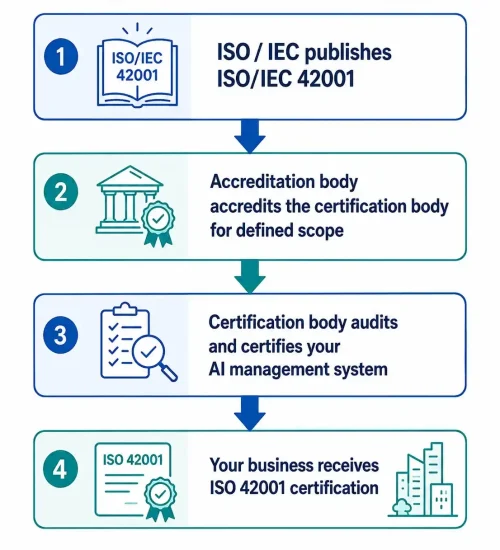
Before relying on a certificate, buyers should verify:
- issuing certification body
- certificate number
- certified organization name
- certification scope
- sites covered
- issue and expiry dates
- accreditation body, where applicable
- certificate status through the certification body, accreditation body directory, or IAF CertSearch where applicable
For deeper guidance, read the internal support page on choosing an accredited ISO 42001 certification body.
ISO 42001 and the EU AI Act
The EU AI Act is one reason more organizations are paying attention to AI governance. Under Article 113, the AI Act applies from 2 August 2026, with some provisions applying earlier and certain obligations under Article 6(1) applying from 2 August 2027.
ISO 42001 does not automatically make an organization legally ready for the EU AI Act. It should not be presented as a replacement for legal review, regulatory analysis, or product-specific obligations.
What it can do is help create a management-system structure around AI governance. That structure can support work related to risk management, accountability, documentation, oversight, monitoring, supplier control, and continual improvement.
For UK, India, US, UAE, and other non-EU companies selling to EU-linked buyers, ISO 42001 can also help answer buyer questions about how AI systems are governed internally.
What ISO 42001 certification does not guarantee
ISO 42001 is useful, but it has limits. Honest limits build trust and reduce overclaiming.
ISO 42001 certification does not guarantee that:
- every AI system is legally acceptable in every country
- a regulator will automatically approve your AI product
- every buyer will accept the certificate without further review
- AI outputs are always fair, safe, accurate, or risk-free
- legal, privacy, cybersecurity, or sector-specific obligations are no longer needed
- ISO 27001 is no longer relevant
- certification can be issued without proper implementation and audit evidence
A credible ISO 42001 route should be honest about these limits from the beginning.
Example scenario: AI-enabled SaaS company
This is an example scenario, not a real case study.
A 70-employee SaaS company provides AI-assisted analytics to enterprise clients in the UK and EU. The company already has ISO 27001 and a basic AI policy, but each product team documents AI decisions differently.
During a procurement review, a buyer asks for evidence of AI risk management, model monitoring, data governance, and supplier control. The company can answer some security questions because of ISO 27001, but its AI governance evidence is incomplete.
A practical ISO 42001 certification pathway would begin by defining the AI management system scope, mapping AI use cases, creating an AI risk register, assigning AI governance responsibilities, improving supplier reviews, documenting monitoring controls, and conducting an internal audit.
After implementation, the company can proceed to certification audit through the relevant certification body route. The real value is not only the certificate. It is the ability to show buyers a clear, structured AI governance system.
How Isofranchise helps
Isofranchise.in operates as a global ISO certification network and facilitation platform. It helps route businesses, consultants, auditors, certification partners, and franchise prospects to the right pathway.
For business buyers, this means you can request guidance based on your country, AI use case, existing certifications, target buyer market, and timeline.
For consultants, auditors, and partners, ISO 42001 creates a growing service opportunity around AI governance and responsible AI management.
Countries Where We Deliver ISO 42001 Certification
- Our network is active in many of the world’s strongest ISO certification markets, including:
Australia — Qatar — Thailand — Egypt — Azerbaijan — Nigeria — United Kingdom — Peru — Brazil — Bangladesh — USA — South Africa — Malaysia — Kuwait — Italy — Ghana — Georgia — Iraq — Kenya — Saudi Arabia — Nepal — Bulgaria — India — Pakistan — Indonesia — Mongolia — Canada — Iran — Germany — Singapore — Sri Lanka — Turkey — UAE — Vietnam and many more.