
ISO 42001 Certification in India
ISO 42001 certification in India is now a strategic priority for any organisation whose AI systems touch customers, data, regulated processes, or export contracts. Published in December 2023, ISO/IEC 42001 is the world’s first management-system standard for artificial intelligence governance. It gives businesses a structured, auditable framework to govern how AI is developed, deployed, and monitored and it gives buyers, regulators, and global clients a verifiable proof point.
Isofranchise connects Indian organisations with certification pathways through our network. Certification is issued by independent, accredited certification bodies.
Last updated: 6
Why You Can Trust This ISO 42001 India Guide
This guide is written for Indian organisations that are exploring ISO 42001 certification for AI management systems. It is designed for IT companies, SaaS teams, AI product businesses, fintech firms, BPOs, GCCs, healthtech companies, analytics providers, and enterprise vendors that need clear information before choosing a certification route.
The page focuses on practical questions that buyers usually ask before starting the process: what ISO 42001 covers, who needs it in India, what documents are usually required, how the audit works, how certification cost is estimated, and how to check whether a certification route is credible.
Isofranchise does not publish ISO standards, does not act as an accreditation body, and does not directly issue ISO 42001 certificates. Isofranchise helps organisations discuss suitable ISO 42001 certification pathways through its network. The certificate is issued by the relevant independent certification body after a successful audit.
Prepared by: ISO Franchise Editorial Team
Page focus: ISO 42001 certification in India
Last reviewed: 6 June 2026
Next review due: 5 December 2026
Correction contact: isofranchise.network@gmail.com
Important verification note: Certification, accreditation, scope, cost, audit duration, and certificate validity should always be checked before relying on any ISO certificate. If your client or tender asks for accredited certification, confirm the certification body, accreditation body, accredited scope, and certificate verification route before proceeding.
ISO 42001 Requirements Explained for Indian Organisations
ISO/IEC 42001 is built around a management system approach. That means it is not only about creating AI policies or preparing documents for an audit. The organisation must show that AI governance is planned, implemented, reviewed, and improved in real business operations.
For Indian companies, this is useful because many AI-related risks are not limited to the technology team. AI systems may affect customer decisions, data use, product quality, employee workflows, supplier relationships, service delivery, and buyer confidence.
The main requirement areas usually include:
Context of the organisation
The organisation needs to understand how AI is used in its business, which internal and external issues affect AI governance, and which interested parties may care about responsible AI use. This may include clients, regulators, investors, procurement teams, users, employees, suppliers, and business partners.
Leadership
Top management must define clear responsibility for AI governance. This includes AI policy, roles, accountability, decision-making authority, and evidence that leadership is involved in reviewing the AI management system.
Planning
The organisation must identify AI-related risks and opportunities. This may include risks linked to bias, poor data quality, lack of transparency, weak human oversight, security exposure, model drift, third-party AI tools, and unclear responsibility for AI-assisted decisions.
Support
The organisation must provide the resources, competence, awareness, communication, and documented information needed to operate the Artificial Intelligence Management System. Staff who work with AI systems should understand their responsibilities and the limits of AI use.
Operation
This is where AI controls are applied in practice. The organisation should be able to show how AI systems are identified, assessed, approved, monitored, changed, and reviewed. It should also show how third-party AI tools and suppliers are managed.
Performance evaluation
The organisation must monitor and review whether the AI management system is working. This includes internal audit, management review, monitoring records, performance indicators, issue tracking, and evidence that controls are actually being followed.
Improvement
When problems are found, the organisation must correct them and address the cause. ISO 42001 certification is not a one-time document exercise. The AI management system must keep improving as AI systems, risks, data sources, and buyer expectations change.
What ISO 42001 Means for Indian Businesses
ISO/IEC 42001 defines the requirements for an Artificial Intelligence Management System (AIMS). It covers the entire AI lifecycle from how you identify AI use cases and assess risks, through how you document and control AI systems, to how you monitor performance and respond to incidents.
For Indian businesses, the standard is not an abstract compliance checkbox. It is a commercial differentiator. Enterprise buyers in the UK and EU now include AI governance certification in procurement requirements. Government and public-sector contracts increasingly expect demonstrable AI risk controls. Your ISO 42001 certificate issued by an accredited body is the evidence that meets that bar.
For IT and SaaS exporters
Credible AI governance proof for UK, EU, and US client procurement
For fintech and regulated firms
Alignment with RBI IT governance guidelines and risk controls
For GCC and BPO operators
Demonstrates responsible AI across AI-enabled delivery models
Who in India Needs ISO 42001 Certification
ISO 42001 is relevant to any organisation that develops, deploys, or uses AI systems as a material part of its operations. Based on current market adoption patterns in India, the following sectors benefit most:
- IT services and software exporters — Global enterprise clients now request AI governance as a procurement condition, particularly for UK, EU, and US contracts
- SaaS and AI-first product companies — Certification supports sales cycles with regulated buyers and strengthens trust in AI-powered features
- Fintech companies — Credit scoring, fraud detection, and KYC AI systems are subject to RBI and SEBI oversight; ISO 42001 provides a documented control framework
- Global Capability Centres (GCCs) — Shared service and analytics functions using AI to support parent companies with EU AI Act obligations
- Healthtech and diagnostics — AI-assisted clinical decision tools require transparent governance and auditability
- E-governance and government tech suppliers — Alignment with MeitY’s responsible AI guidelines and India’s AI governance principles
- BPO and analytics operations — Client contracts increasingly include AI ethics and governance requirements
If your organisation uses AI and needs to demonstrate that use is governed, controlled, and auditable — ISO 42001 is the right standard.
Documents Required for ISO 42001 Certification in India
The exact documents required for ISO 42001 certification in India depend on the organisation’s size, AI scope, number of AI systems, risk level, locations, and existing management systems such as ISO 27001 or ISO 9001.
Most organisations should prepare the following records before the certification audit:
- Scope of the Artificial Intelligence Management System
- AI policy
- AI objectives
- AI system inventory
- Roles and responsibilities matrix
- AI risk assessment methodology
- AI risk register
- AI impact assessment records
- AI lifecycle procedure
- Data governance procedure
- Data quality and data source records
- Human oversight procedure
- Model testing and validation records, where applicable
- AI monitoring and performance review records
- Third-party AI tool and supplier records
- Incident and issue management records
- Internal audit report
- Management review minutes
- Corrective action records
- Training and awareness records
- Applicable legal, contractual, and buyer requirement register
- Records for changes made to AI systems, models, data sources, or workflows
A common mistake is preparing documents that are not connected to actual AI use cases. A stronger ISO 42001 system links every policy, risk, control, and monitoring activity to real AI systems used by the organisation.
For example, if a SaaS company uses AI for customer support automation, the AI inventory should identify that system, the risk assessment should evaluate its impact, the human oversight process should explain when staff review outputs, and the monitoring records should show how performance or errors are tracked.
What Auditors Check During an ISO 42001 Audit
During an ISO 42001 audit, the auditor does not only look for policies. The auditor checks whether the Artificial Intelligence Management System is implemented and working in practice.
For Indian organisations, auditors may review evidence such as:
- Whether the organisation has clearly identified its AI systems
- Whether the AIMS scope matches actual AI use
- Whether AI risks are assessed before deployment or major change
- Whether AI impact assessments are completed where needed
- Whether data quality, data source, and data use controls are documented
- Whether human oversight is defined for important AI-assisted decisions
- Whether staff understand their AI responsibilities
- Whether third-party AI tools are reviewed and approved
- Whether AI outputs are monitored after deployment
- Whether AI-related issues are reported, reviewed, and corrected
- Whether internal audit and management review have been completed
- Whether corrective actions are closed with evidence
If an organisation says it checks AI bias, the auditor may ask which AI system was checked, what data was used, what indicators were reviewed, who reviewed the result, and what action was taken if a problem was found.
If an organisation says human oversight is applied, the auditor may ask who has authority to review AI-assisted decisions, when human review is required, how the review is recorded, and how staff are trained for that responsibility.
If an organisation uses third-party AI tools, the auditor may ask which tools are used, what data is shared with them, what risks are linked to their use, who approves them, and how supplier or vendor changes are monitored.
This is why ISO 42001 certification should not be treated as a paperwork project. The system has to work in daily operations.
Typical ISO 42001 Certification Timeline in India
The timeline for ISO 42001 certification in India depends on readiness. A company with strong governance records, ISO 27001 experience, and a limited AI scope may move faster. A larger organisation with multiple AI systems, product teams, locations, suppliers, and risk areas will usually need more preparation time.
A practical timeline may look like this:
Small company or startup
A small SaaS company, AI startup, analytics team, or product company with a limited AI scope may move faster if its AI inventory, risk assessment, policies, and records are already organised. The main work is usually defining the scope clearly and creating evidence that controls are being followed.
Mid-size IT, SaaS, fintech, or BPO company
A mid-size organisation may need more time because AI use often sits across product, delivery, data, security, legal, and operations teams. The company may need to connect AI risk assessment, impact assessment, supplier control, monitoring, internal audit, and management review records.
Large enterprise or multi-location organisation
A large organisation may need a wider planning period because the AIMS scope may include several departments, AI products, data sources, locations, suppliers, and customer-facing systems. The audit effort may also increase if different sites or business units are included in the certification scope.
The most common delay happens when policies exist but implementation evidence is weak. Before applying for certification, Indian organisations should check whether they have:
- AI system inventory
- Defined AIMS scope
- AI policy and objectives
- AI risk assessment records
- AI impact assessment records
- Data governance controls
- Human oversight process
- AI monitoring records
- Internal audit report
- Management review records
- Corrective action process
- Third-party AI control records
A ready organisation can move through the process faster because the certification body can review real evidence instead of waiting for missing records.
ISO 42001 and ISO 27001 for Indian Companies
ISO 27001 and ISO 42001 work well together, but they do not cover the same thing.
ISO 27001 focuses on information security. It helps protect the confidentiality, integrity, and availability of information.
ISO 42001 focuses on the management of artificial intelligence systems. It looks at how AI systems are governed, how risks are assessed, how human oversight is defined, how data quality is controlled, and how AI performance is monitored after use.
For Indian IT companies, SaaS providers, fintech firms, BPOs, GCCs, and AI product teams, the two standards can support each other.
ISO 27001 may already give the organisation useful controls for access management, supplier review, incident handling, risk treatment, internal audit, management review, and documented information. ISO 42001 adds AI-specific governance around AI inventory, AI risk assessment, AI impact assessment, human oversight, transparency, monitoring, and continual improvement.
If your organisation already has ISO 27001, it may be easier to build an ISO 42001-ready system because many management system practices are already familiar. However, ISO 42001 still needs AI-specific evidence. A generic information security system is not enough by itself.
ISO 42001 and SOC 2 Readiness for Indian SaaS Companies
Many Indian SaaS companies work with US, UK, EU, and enterprise clients that already ask for SOC 2, ISO 27001, security questionnaires, vendor due diligence, and risk evidence.
ISO 42001 is different from SOC 2, but existing SOC 2 readiness work can support ISO 42001 preparation in some areas.
For example, a SaaS company may already maintain records for access control, incident management, vendor review, risk assessment, change management, monitoring, and internal review. These records can help create a stronger foundation for ISO 42001.
However, ISO 42001 also needs AI-specific evidence. This may include AI system inventory, AI risk assessment, AI impact assessment, data quality controls, AI lifecycle controls, human oversight, monitoring of AI outputs, and review of third-party AI tools.
For Indian SaaS teams selling AI-enabled products to global clients, ISO 42001 can help answer a buyer’s practical question: how do you control the AI features inside your product or service?
ISO 42001 and India’s AI Governance Landscape
India does not currently have a single AI law that works exactly like the EU AI Act. Still, Indian organisations are under growing pressure to show that AI is governed properly, especially when AI systems touch personal data, customer decisions, regulated workflows, financial processes, healthcare use cases, or global client delivery.
For many companies, ISO 42001 is useful because it gives a structured way to manage AI risk, accountability, monitoring, human oversight, and continual improvement.
DPDPA 2023 and AI systems using personal data
The Digital Personal Data Protection Act, 2023 is important for organisations that process digital personal data in India. If AI systems use personal data for training, analysis, inference, decision support, automation, or customer workflows, the organisation should have clear controls around data use, purpose, access, retention, and accountability.
ISO 42001 does not replace legal review under DPDPA. It should not be presented as a guarantee of legal compliance. However, it can support stronger AI governance by helping the organisation document how AI systems are identified, risk-assessed, controlled, monitored, and improved.
In practical terms, ISO 42001 can help Indian organisations organise evidence around:
- AI policy and responsibility
- AI system inventory
- AI risk assessment
- AI impact assessment
- Data use documentation
- Human oversight
- Monitoring and review
- Corrective action where problems are found
MeitY and responsible AI expectations
Indian policy discussions around responsible AI continue to focus on safety, trust, transparency, accountability, and responsible use. For companies building or using AI systems, these expectations are becoming part of buyer conversations even when certification is not legally mandatory.
ISO 42001 can help convert broad responsible AI expectations into an auditable management system. This is useful for organisations that need to show clients, boards, investors, or procurement teams that AI governance is not handled casually.
EU AI Act and Indian exporters
Indian IT, SaaS, analytics, AI product, and service companies that work with EU-linked clients may face buyer-side questions about AI governance. The EU AI Act has phased application dates, and some EU clients may ask suppliers to show how AI systems are governed, monitored, and controlled.
This does not mean every Indian company automatically needs ISO 42001 certification. The need depends on the AI system, market, client requirement, risk level, and contractual expectations.
For Indian exporters and global vendors, ISO 42001 can be useful because it provides a recognised structure for documenting AI governance. It can help answer client questions about AI risk assessment, data quality, human oversight, transparency, monitoring, supplier control, and continual improvement.
How to Get ISO 42001 Certified in India
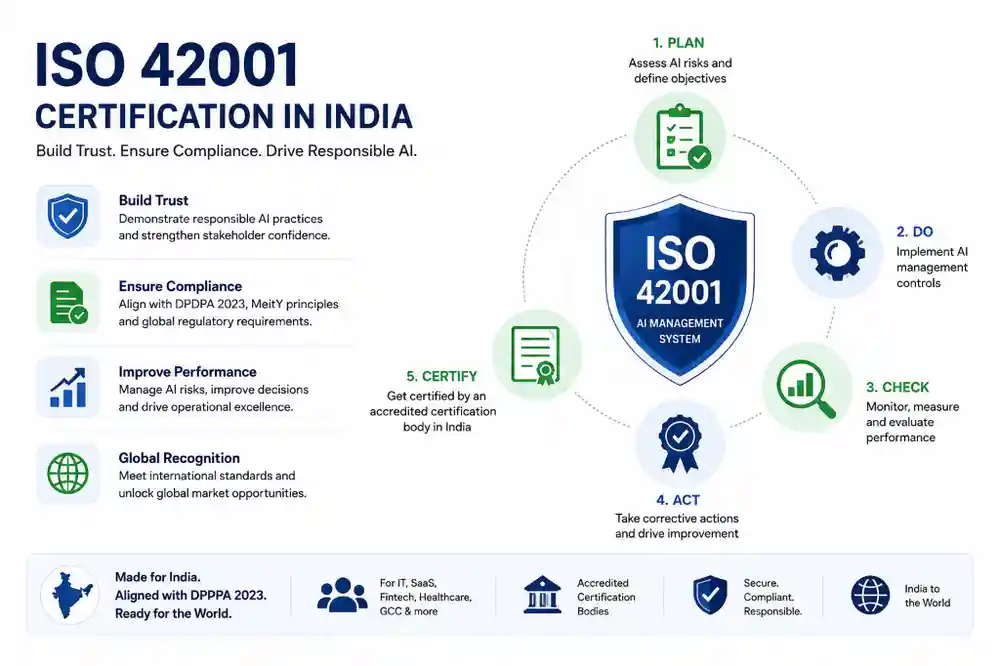
The certification process follows the same internationally recognised stages used for ISO 27001 and other management-system standards. For most Indian organisations, the total timeline from starting implementation to receiving a certificate is three to nine months, depending on size and existing governance maturity.
Step 1 — Define your AI scope Identify which AI systems, processes, and organisational units will fall within your AIMS scope. This boundary decision affects audit cost and timeline.
Step 2 — Conduct a gap analysis Assess your current AI governance controls against ISO 42001 requirements. Most organisations find gaps in documentation, risk assessment processes, and internal oversight structures.
Step 3 — Build and document your AIMS Develop the required policies, procedures, and controls. Key documents include your AI policy, AI risk assessment methodology, AI system inventories, and evidence of leadership commitment.
Step 4 — Implement and operate Run your AIMS for a sufficient period — typically a minimum of three months — to generate operational evidence that controls are working.
Step 5 — Internal audit and management review Conduct a mandatory internal audit to verify readiness. Address any non-conformities before the external audit. Management review must formally confirm the AIMS is suitable and effective.
Step 6 — Stage 1 and Stage 2 external audit An accredited certification body conducts a two-stage audit. Stage 1 is a documentation review to assess readiness. Stage 2 is the full implementation audit — on-site or remote — to verify your AIMS is operating effectively.
Upon successful completion of Stage 2, the certification body issues your ISO 42001 certificate. The certificate is valid for three years, with annual surveillance audits in years two and three.
For a detailed step-by-step guide including documents needed and common failure points, see our How to Get ISO 42001 Certification guide.
How to Choose an Accredited Certification Body in India
Choosing the right certification body matters. Not all certification bodies offering ISO 42001 audits are accredited for the ISO/IEC 42001 standard, and an unaccredited certificate may not be accepted by regulated buyers, procurement teams, or government contracts.
What accreditation means
An accredited certification body has been assessed by a national or international accreditation body such as the Quality Council of India (QCI/NAB), UKAS (UK), or ANAB (USA) against international standards for certification competence. Accreditation confirms the certification body is technically qualified to audit and issue certificates for a defined scope.
IAF (the International Accreditation Forum) is not a certification body and does not issue ISO 42001 certificates. It is the global association that recognises national accreditation bodies. Where you see the phrase “IAF approved certification body,” the more accurate and useful question is: Is this certification body accredited for ISO/IEC 42001 by a named accreditation body, and can I verify that accreditation?
How to verify a certification body and your certificate
- Ask the certification body for the name of their accreditation body and the specific scope of their accreditation
- Check the accreditation body’s online directory for example, the NAB India directory or UKAS directory to confirm the certification body is listed and the scope includes ISO 42001
- After certification, your certificate can be verified through IAF CertSearch where applicable
Isofranchise.in connects organisations to certification pathways through partners in our network. We do not issue certificates or hold accreditation ourselves. We help you identify the right route and connect you with the appropriate accredited body for your market and industry.
ISO 42001 Certification Cost in India
Certification costs in India vary based on organisation size, the number of AI systems in scope, existing governance maturity, and the certification body selected. The figures below are indicative ranges — not fixed prices. Request a tailored quote for an accurate estimate.
| Organisation size | Indicative total certification cost (INR) | Typical timeline |
|---|---|---|
|
Small (up to 50 staff, limited AI scope) |
₹2 lakh – ₹5 lakh |
3–5 months |
|
Medium (50–500 staff, multiple AI systems) |
₹5 lakh – ₹12 lakh |
5–8 months |
|
Large / complex (500+ staff, high-risk AI, multi-site) |
₹12 lakh – ₹25 lakh+ |
7–12 months |
What drives cost
- Number of AI systems and use cases in scope
- Whether existing ISO 27001 or ISO 9001 documentation reduces gap-analysis effort
- Organisation size and number of audit days required
- On-site vs. remote audit logistics
- Annual surveillance audit fees in years two and three
- Consultancy support if internal implementation resource is limited
These are indicative ranges based on market information as of 2026. Actual costs depend on your specific scope, the certification body selected, and your existing governance maturity. Request a tailored quote for accurate figures.
How Isofranchise Helps Indian Organisations
Isofranchise operates as a certification network and lead-routing platform. We do not publish ISO standards, issue certificates, or hold accreditation. What we do is connect organisations seeking ISO 42001 certification with accredited certification partners and consultants who can guide implementation and conduct audits.
Why use our network:
- Route matching — We identify the right accredited certification body for your industry, size, and target markets
- India and global coverage — Partners serving IT hubs including Bangalore, Hyderabad, Pune, Chennai, Gurgaon, and Mumbai
- Standard integration — If you already hold ISO 27001, we help identify certification bodies that can combine audit scope
- Fast response — Initial scoping call typically within two business days of your enquiry
Isofranchise is a certification network and lead-routing platform. It is not an accreditation body and does not publish ISO standards. Certification is issued by independent, accredited certification bodies. Accreditation is held by the relevant national or international accreditation body. Always verify a certification body’s accredited scope before proceeding.
ISO 42001 Certification Across Indian Technology Hubs
Indian organisations exploring ISO 42001 certification are often based in technology, SaaS, IT services, fintech, healthcare technology, outsourcing, and AI-enabled business hubs. These companies may need a clearer AI governance structure when working with enterprise buyers, global clients, regulated sectors, or international procurement teams.
Bangalore
Bangalore is relevant for SaaS companies, IT service providers, AI startups, product engineering teams, and global capability centres that need stronger AI governance evidence for enterprise buyer reviews.
Hyderabad
Hyderabad has a strong technology and healthcare ecosystem, making ISO 42001 relevant for AI-enabled analytics, pharma-tech, SaaS, cybersecurity, and global delivery teams.
Pune
Pune organisations may explore ISO 42001 certification when AI is used in automotive technology, manufacturing systems, engineering services, enterprise software, and IT delivery operations.
Chennai
Chennai has demand from IT exporters, BPO operations, manufacturing supply chains, and AI-enabled service teams that need structured controls for AI use, supplier review, monitoring, and documentation.
Mumbai
Mumbai is relevant for fintech, financial services, analytics, insurance technology, and enterprise vendors that need stronger evidence around AI governance, risk control, and buyer assurance.
Delhi NCR and Gurgaon
Delhi NCR and Gurgaon include enterprise technology providers, consulting-led delivery teams, government-linked suppliers, fintech firms, and AI-enabled service companies that may need ISO 42001 readiness for buyer or tender review.
Isofranchise helps organisations in India discuss suitable ISO 42001 certification pathways through its network. For the full certification process, read our guide on how to get ISO 42001 certification.
Offer ISO 42001 Certification Services in India
Are you an ISO consultant, lead auditor, or compliance professional looking to add ISO 42001 to your service line? India’s AI governance market is growing rapidly, and demand for qualified ISO 42001 implementation and audit support significantly exceeds current supply.
Isofranchise works with a network of partners across India. If you have experience with ISO management systems and want to build an ISO 42001 revenue stream, explore the partner model.
Source, Review and Update Policy
This ISO 42001 certification in India page is maintained to provide practical guidance for organisations planning to certify their Artificial Intelligence Management System.
The content is reviewed to keep it aligned with:
- ISO/IEC 42001:2023 Artificial Intelligence Management System requirements
- ISO management system audit practices
- Certification body and accreditation route awareness
- AI governance and risk management expectations
- India-focused buyer, vendor, and procurement questions
- Certificate verification and scope-checking guidance
This page should be reviewed and updated when:
- ISO 42001 certification rules or market expectations change
- Accreditation or certificate verification requirements change
- AI governance requirements affect Indian organisations
- Buyer expectations change for Indian IT, SaaS, fintech, BPO, GCC, or AI product companies
- New FAQs become common from Indian organisations
- Isofranchise updates its route-selection or partner network guidance
Content owner: ISO Franchise Editorial Team
Review focus: ISO 42001 certification in India, AI governance, certification route selection, audit readiness, certificate verification, and buyer-focused certification planning
Last reviewed: 6 June 2026
Next review due: 6 December 2026
Correction contact: isofranchise.network@gmail.com
This page is for general certification guidance. Final certification requirements, audit duration, cost, accreditation status, certificate scope, and verification route are confirmed after application review by the relevant certification body.
Frequently asked questions
ISO 42001 certification in India is independent confirmation that an organisation’s Artificial Intelligence Management System has been audited against ISO/IEC 42001:2023 within a defined scope. It is relevant for Indian organisations that develop, provide, integrate, or use AI systems in business operations.
ISO 42001 may be useful for Indian IT companies, SaaS providers, AI startups, fintech firms, healthtech companies, BPOs, GCCs, analytics providers, cybersecurity companies, and enterprise vendors that need to show stronger AI governance evidence to clients or procurement teams.
No. ISO 42001 is generally voluntary in India unless a client, tender, contract, regulator, or buyer requirement asks for it. Even when it is not mandatory, it can help organisations create a structured AI governance system and provide clearer evidence during vendor review.
ISO 42001 certification is issued by an independent certification body after a successful audit. If your client requires accredited certification, you should verify the issuing certification body, the accreditation body, the accredited scope, and the certificate verification route before proceeding.
An accredited ISO 42001 certification body is a certification body assessed by an accreditation body for a defined scope related to ISO/IEC 42001 certification. Buyers should check the certification body name, accreditation body, accredited scope, certificate status, and verification route before relying on a certificate.
Many people search for this phrase, but it is not the safest technical wording. IAF does not normally certify companies or issue ISO 42001 certificates. The better question is whether the certification body is accredited for the relevant scope and whether the certificate can be verified.
ISO 42001 certification cost in India depends on the organisation size, number of employees, number of AI systems, certification scope, number of locations, audit duration, existing governance maturity, and certification route. A tailored quote is needed for an accurate cost.
The main cost factors include AI system complexity, risk level, number of sites, number of employees covered by the AIMS, existing ISO 27001 or ISO 9001 certification, readiness of documents, audit delivery model, and whether an accredited certification route is required by the client.
The timeline depends on readiness. Smaller companies with limited AI scope and organised records may move faster. Larger organisations with multiple AI systems, sites, suppliers, and risk areas usually need more preparation time before the certification audit.
Common documents include AIMS scope, AI policy, AI objectives, AI system inventory, AI risk assessment, AI impact assessment, data governance procedure, human oversight procedure, monitoring records, internal audit report, management review records, corrective action records, and training records.
Auditors check whether the AI management system is implemented in practice. They may review AI inventory, scope, risk assessments, impact assessments, human oversight, data quality controls, third-party AI controls, monitoring records, internal audit, management review, and corrective actions.
Yes. ISO 42001 can work well with ISO 27001 because AI governance and information security often overlap. ISO 27001 supports information security controls, while ISO 42001 focuses on AI-specific governance, risk, impact assessment, human oversight, monitoring, and improvement.
Yes. ISO 42001 can be useful for Indian SaaS companies that use AI features, AI automation, AI analytics, AI recommendations, AI-assisted customer support, or AI-enabled product workflows. It helps organise AI governance evidence for enterprise buyers and global clients.
Yes. Fintech companies may use AI for fraud detection, credit scoring, KYC support, risk modelling, customer support, analytics, or transaction monitoring. ISO 42001 can help document AI governance, risk assessment, human oversight, monitoring, and accountability for these systems.
ISO 42001 does not replace legal review under DPDPA 2023. However, where AI systems process personal data, ISO 42001 can support better governance by helping the organisation document AI scope, risk assessment, data use, responsibility, monitoring, and corrective action.
It can help. Indian companies serving EU-linked clients may be asked to show how AI systems are governed, risk-assessed, monitored, and controlled. ISO 42001 gives a structured way to present AI governance evidence, but the exact need depends on client, contract, scope, and AI risk.
Ask for the certificate number, certified organisation name, issuing certification body, certification scope, sites covered, issue date, expiry date, and accreditation details where applicable. Then verify the certificate through the certification body or relevant verification route.
Yes. Small companies can pursue ISO 42001 certification if they develop, provide, integrate, or use AI systems. The certification scope and audit duration should match the actual size, AI use, risk level, and business activities of the organisation.
No. Isofranchise does not issue ISO 42001 certificates and is not an accreditation body. Isofranchise helps organisations discuss suitable certification pathways through its network. Certification is issued by the relevant independent certification body after a successful audit.
Before requesting a quote, prepare your organisation name, country, number of employees, number of sites, AI products or use cases, required certification scope, existing ISO certifications, target buyer market, preferred timeline, and any client or tender requirement.